









i. Air sacs and alveoli
Answer: Air sacs and alveoli are the same structures. Alveoli is the scientific term for the tiny air sacs in the lungs. j. Oxyhaemoglobin and carboxyhaemoglobin
Answer: Oxyhaemoglobin is hemoglobin bound to oxygen. Carboxyhaemoglobin is hemoglobin bound to carbon monoxide.
8. Breathing through nose is healthier than breathing by mouth. Why?
Answer: Breathing through the nose is healthier because:
Filtration: Nasal hairs and mucus trap dust, pollen, and pathogens.
Warming: Blood vessels in the nose warm the air to body temperature. Humidification: Mucus adds moisture to the air, preventing dryness in the lungs. Nitric Oxide: The nose produces nitric oxide, which helps kill bacteria and improves oxygen uptake.
9. What are the conditions necessary for efficient gaseous exchange between organism and environment?
Answer: Conditions for efficient gaseous exchange:
Large Surface Area: To allow more gas molecules to diffuse at once. Thin Membrane: To provide a short diffusion path. Concentration Gradient: To maintain diffusion. Moist Surface: To allow gases to dissolve. Rich Blood Supply: To transport gases away and maintain the gradient.
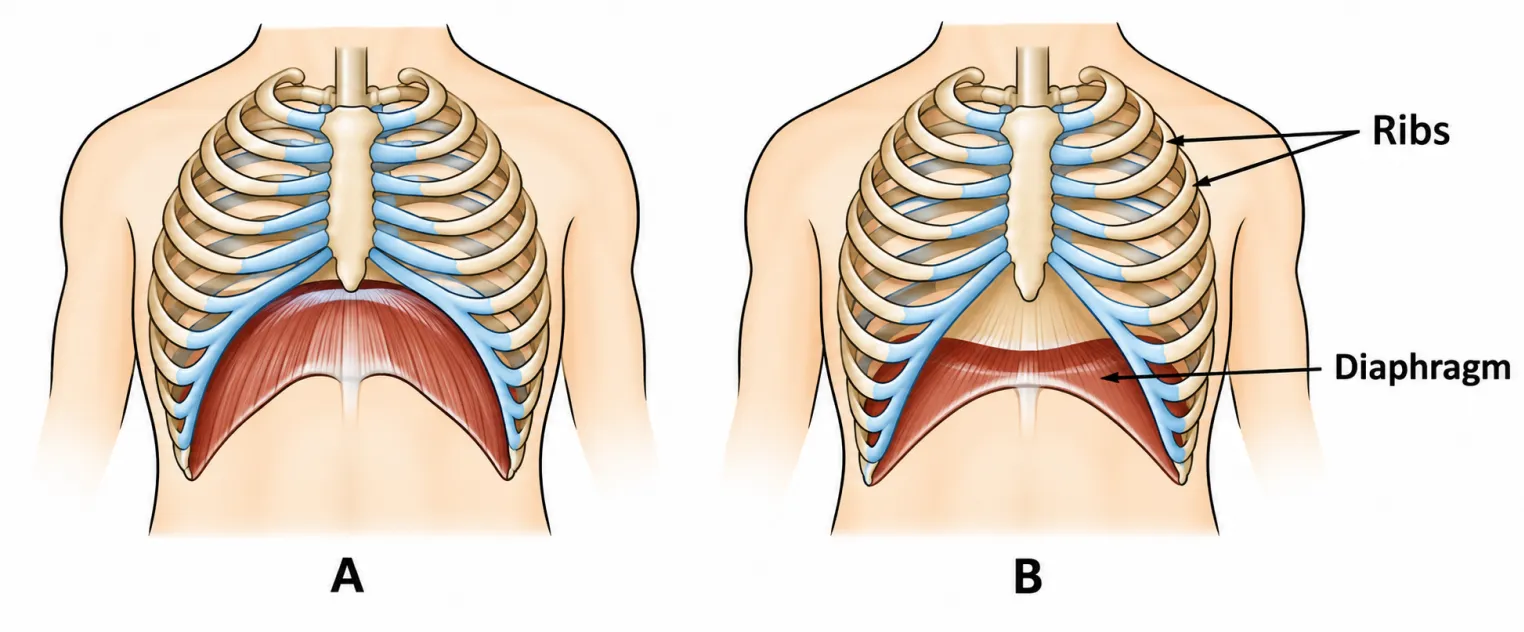
10. The two steps of breathing are shown in the given diagrams. Which of the given diagrams, A or B, shows the process of exhalation? Support your answer with a reason.
(Diagram A: Ribs raised, Diaphragm flattened. Diagram B: Ribs lowered, Diaphragm domed)
Answer: Diagram B shows the process of exhalation.
Reason: In diagram B, the ribs are lowered, and the diaphragm is domed upward. This indicates that the thoracic cavity volume has decreased, increasing pressure and forcing air out of the lungs, which is exhalation.
11. Describe the effects of cigarette smoking on the inner walls of trachea of human beings.
Answer: Cigarette smoke damages the cilia and mucous membranes lining the trachea. The cilia are paralyzed and destroyed,
reducing the ability to clear mucus and debris. This leads to the accumulation of tar and pathogens, causing chronic coughing, increased risk of infections, and chronic bronchitis.
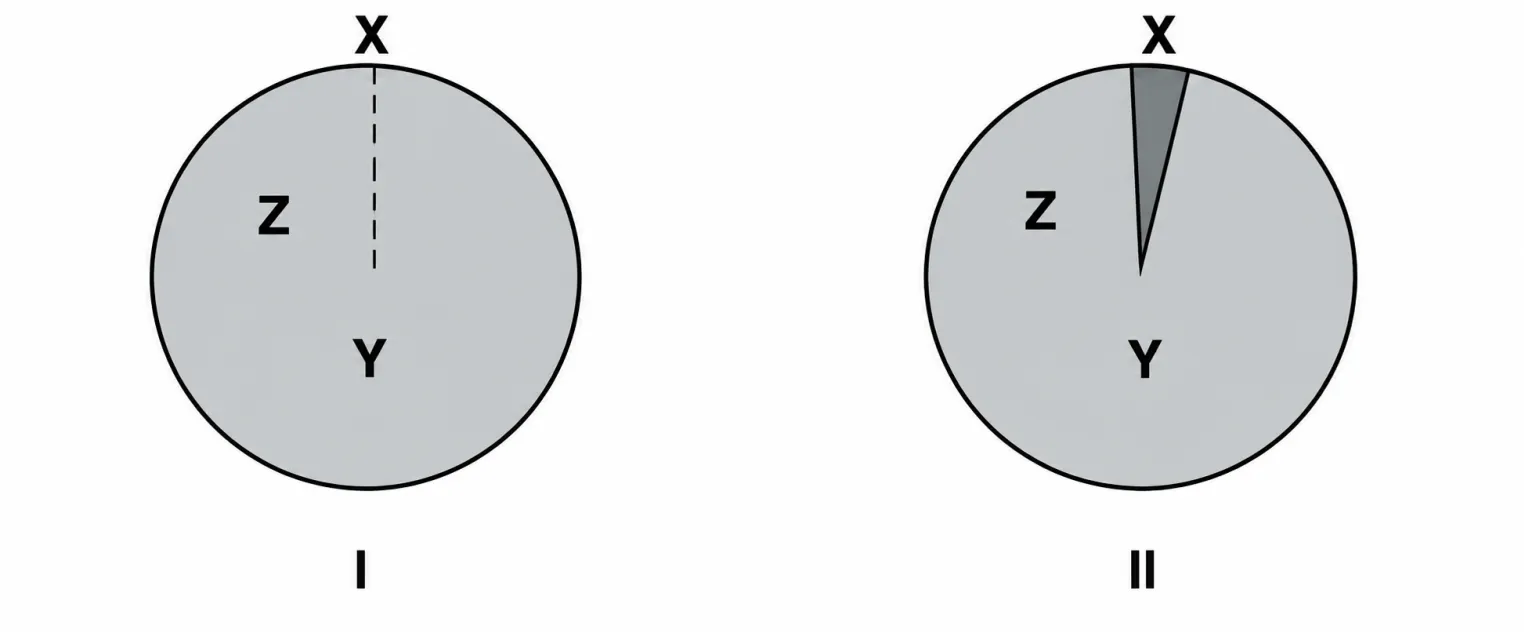
12. The diagram shows percentage of gases in inspired and expired air.
(Diagram: I: Z is largest, Y next, X smallest. II: Y is largest, Z next, X largest)
Answer:
I = Inspired Air, II = Expired Air.
X = Carbon Dioxide (increases from I to II).
Y = Oxygen (decreases from I to II).
Z = Nitrogen (remains constant).
Answer: Gas X is Carbon Dioxide. It is almost negligible (0.04%) in inspired air because it is a waste product produced by cells and removed by the lungs. Atmospheric air contains very little CO₂.
Answer: The percentage of CO₂ increases to about 4% in expired air because it is produced by cellular respiration in the body's tissues and transported by the blood to the lungs for excretion.
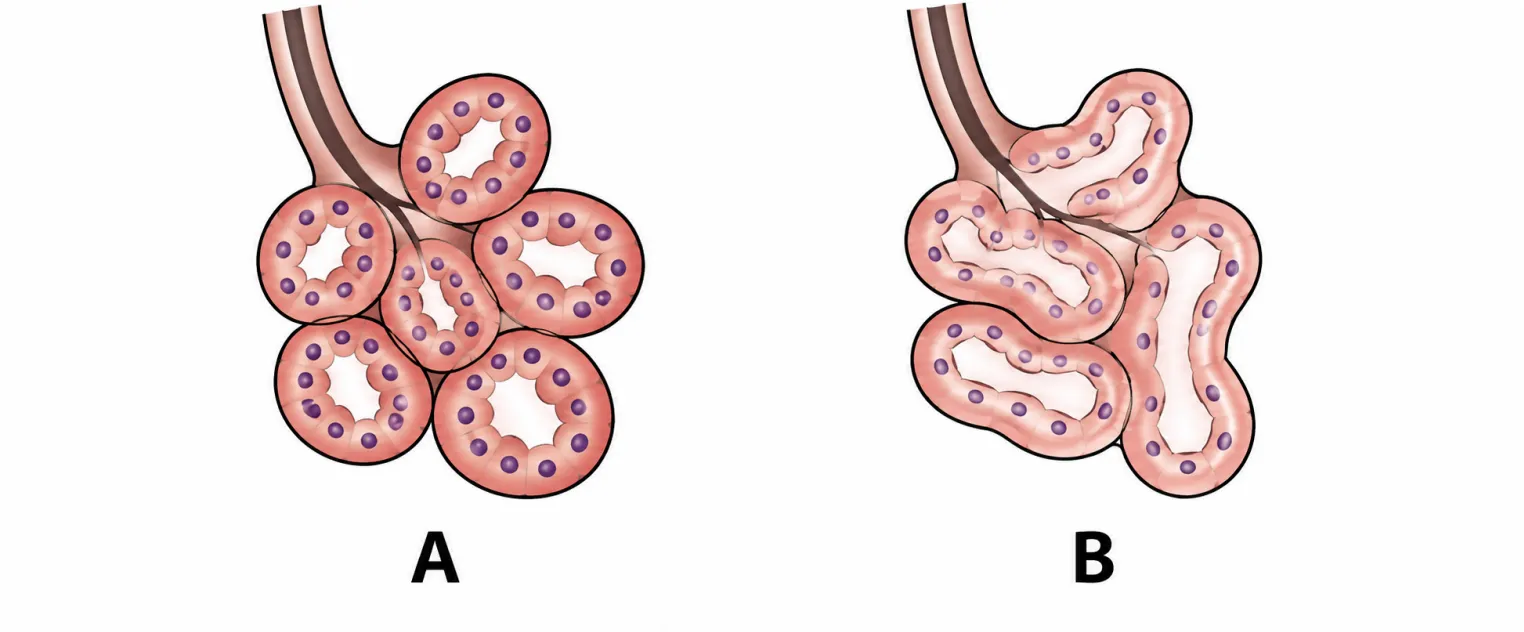
13. The figure shows a healthy lung and a diseased lung.
(Diagram A: normal alveoli. Diagram B: enlarged, merged alveoli)
Answer: The disease is Emphysema. The affected part is the alveoli (air sacs).
Answer: In part B, the alveolar walls are destroyed, causing the alveoli to merge into larger, irregular air spaces. This reduces the surface area for gas exchange.
Answer: Shortness of breath and chronic cough.
14. The diagram shows structural and functional unit of lungs.
(Diagram of an alveolus with capillary network)
Answer: Z is the alveolus (air sac).
Answer: X is Carbon Dioxide (exiting blood). Y is Oxygen (entering blood).
Answer: The blood leaving at point E is oxygenated blood (carried by the pulmonary vein).
15. How nose and nasal cavity function in filtering incoming air?
Answer: The nose and nasal cavity filter incoming air through:
Hairs (vibrissae): Trap large particles. Mucus: Traps smaller particles and pathogens. Cilia: Beat to move mucus and trapped particles toward the pharynx to be swallowed. Turbinates: Increase surface area and create turbulence, improving filtration.
16. What is the role of 'pharynx' in human respiration?
Answer: The pharynx (throat) is a common passage for both air and food. In respiration, it conducts air from the nasal cavity to the larynx. It is lined with mucous membrane that continues to filter and humidify the air. The epiglottis prevents food from entering the airway during swallowing.