









PhysicsChapter 4: Rotational and Circular Motion
Angular Displacement
4.1.2 Angular Displacement
9. Definition of Angular Displacement
Angular displacement is the change in angular position of a rotating object.
Δθ = θf − θi
Where:
- θ_i is the initial angular position.
- θ_f is the final angular position.
10. Sign Convention
A common convention is:
- Anticlockwise rotation: positive
- Clockwise rotation: negative
Therefore:
Δθ > 0
for anticlockwise rotation, and:
Δθ < 0
for clockwise rotation.
The selected convention must remain consistent throughout the problem.
11. Angular Displacement as a Vector
Angular displacement has a direction along the axis of rotation.
Its direction is determined through the right-hand rule:
- Curl the fingers of the right hand in the direction of rotation.
- The extended thumb indicates the angular-displacement direction.
For rotation in a plane, this direction is perpendicular to the plane of rotation.
12. Radian
One radian is the angle subtended at the centre of a circle by an arc whose length is equal to the circle’s radius.
If:
s = r
then:
θ = sr θ = 1 rad
13. Angular Unit Conversions
One complete revolution is:
1 rev = 360° = 2π rad
Therefore:
180° = π rad
Degree to radian conversion:
θrad = θdegree × (π / 180)
Radian to degree conversion:
θdegree = θrad × (180π)
Also:
1 rad ≈ 57.3°
14. Solved Example: Degree to Radian
Question: Convert 120° into radians.
Formula
θrad = θdegree × (π / 180)
Solution
θrad = 120 × (π / 180) θrad = 2π / 3 θrad ≈ 2.09 rad
Final Answer
θ ≈ 2.09 rad
15. Arc Length
From:
θ = sr
Arc length is:
s = rθ
This equation must use θ in radians.
All particles in a rigid rotating body have the same angular displacement, but their arc lengths depend on their distances from the axis.
16. Diagram Placement
Rotational Kinematics
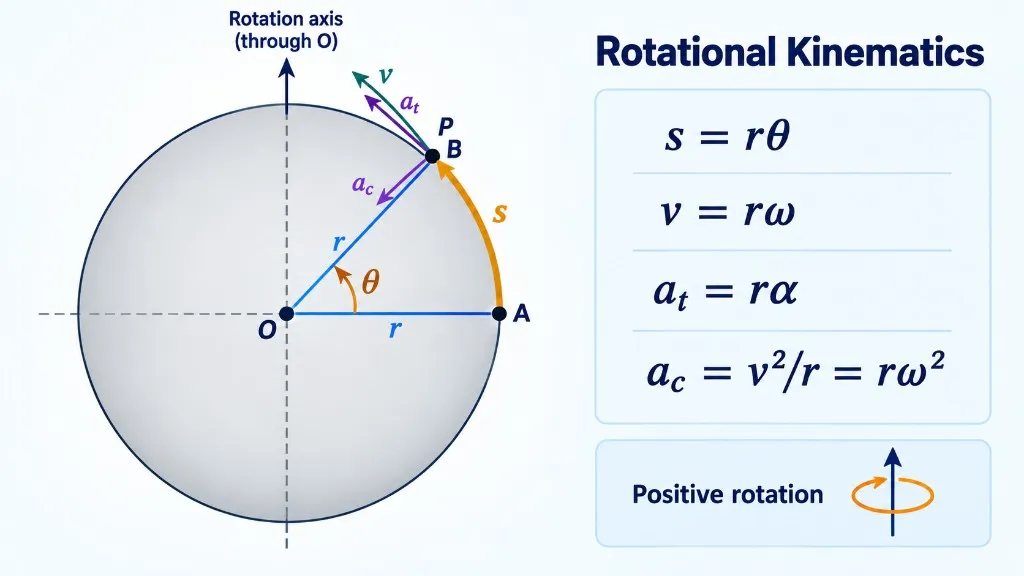
Keep its formulas available separately as searchable HTML:
s = rθ v = rω at = rα ac = v²r = rω²
Did you understand this topic?
Your answer is saved with your learning record. It does not mark the topic as mastered.
Exam preparation
Exam Focus
Quick revision
Revision Zone
Review the key facts, formulas and checks before you move on.Angular Displacement
Sticky Notes · Quick Revision
Core ideas
- Δθ = θf − θi
- 1 rev = 2π rad = 360°
- s = rθ (θ in radians)
Same supplied content as this Notes page (shared canonical source).