









Moment of Inertia
Overview
Moment of inertia describes how strongly an object resists a change in its rotational motion. It is also called rotational inertia.
Mass measures resistance to linear acceleration, while moment of inertia measures resistance to angular acceleration.
Learning Outcomes
After studying this topic, students should be able to:
- Define moment of inertia.
- Explain why it is the rotational equivalent of mass.
- Calculate moment of inertia for point masses.
- Calculate the total moment of inertia of several particles.
- State its SI unit and dimensions.
- Explain how mass distribution affects rotational inertia.
- Use standard formulas for uniform objects.
1. Definition
It is represented by:
I
2. Moment of Inertia of a Point Mass
Consider a small object of mass m located at a perpendicular distance r from the axis of rotation.
Its moment of inertia is:
I = mr²
Where:
- I = moment of inertia
- m = mass of the particle
- r = perpendicular distance from the axis of rotation
Key Logic
The formula contains r². Therefore, distance has a stronger effect than mass.
If mass doubles:
I′ = 2mr² I′ = 2I
If distance doubles:
I′ = m(2r)² I′ = 4mr² I′ = 4I
Therefore, doubling the distance makes the moment of inertia four times greater.
3. Moment of Inertia of a Rigid Body
A rigid body can be treated as a large collection of small masses.
Suppose its particles have masses:
m₁, m₂, m₃, …, mₙ
Their perpendicular distances from the rotation axis are:
r₁, r₂, r₃, …, rₙ
The total moment of inertia is:
I = m₁r₁² + m₂r₂² + m₃r₃² + ⋯ + mₙrₙ²
Using summation notation:
I = Σ mᵢ rᵢ²
Each particle contributes according to its mass and its distance from the axis.
Important Observation
A particle lying exactly on the rotation axis has:
r = 0
Therefore:
I = m(0)² I = 0
That particle does not contribute to the moment of inertia about that axis.
4. Factors Affecting Moment of Inertia
Moment of inertia depends on:
Mass of the object
A greater mass normally produces a greater moment of inertia.
Distribution of mass
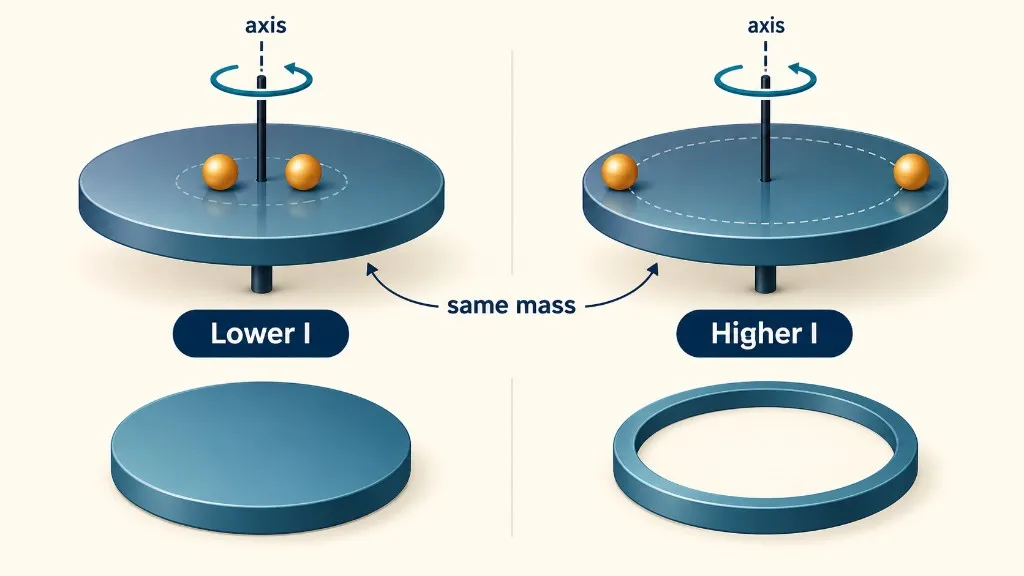
Mass located farther from the axis produces a much greater moment of inertia.
Position of the rotation axis
The same object can have different moments of inertia about different axes.
Shape and size of the object
A ring, disc, sphere and rod distribute their masses differently, so their moments of inertia are different.
Moment of Inertia
Searchable formulas: I = mr² · I = Σ mᵢ rᵢ² · Idisc = ½ MR² · Iring = MR²
5. SI Unit and Dimensions
From:
I = mr²
The SI unit is:
kg · m² SI unit of I = kg m²
Dimensional formula:
[I] = [M][L]² [I] = [ML²]
Moment of inertia is a scalar quantity for rotation about a specified fixed axis.
6. Standard Formulas for Uniform Objects
These formulas apply only to the stated rotation axes.
Standard Formulas for Uniform Objects
| Uniform object | Position of rotation axis | Moment of inertia |
|---|---|---|
| Thin rod of length L | Through centre, perpendicular to rod | I = (112) ML² |
| Thin rod of length L | Through one end, perpendicular to rod | I = (13) ML² |
| Rectangular plate of sides a, b | Through centre, perpendicular to plate | I = (112) M(a² + b²) |
| Rectangular plate | Through a corner, perpendicular to plate | I = (13) M(a² + b²) |
| Solid cylinder or disc | About its central symmetry axis | I = (12) MR² |
| Thin ring or hoop | About its central symmetry axis | I = MR² |
| Thick hollow cylinder | About its central symmetry axis | I = (12) M(R₁² + R₂²) |
| Solid sphere | About a diameter | I = (25) MR² |
| Thin hollow sphere | About a diameter | I = (23) MR² |
Here:
- M = total mass
- R = radius
- R₁ = inner radius
- R₂ = outer radius
- L = length
- a, b = sides of the rectangular plate
Always identify the rotation axis before selecting a formula.
7. Comparison Between a Disc and a Ring
For a solid disc:
Idisc = (12) MR²
For a thin ring:
Iring = MR²
Therefore:
Iring = 2 Idisc
A ring has a greater moment of inertia because most of its mass is concentrated at the outer radius. In a disc, some mass lies closer to the axis.
Solved Examples
Example 1: Single Point Mass
A 3 kg particle rotates at a distance of 0.40 m from an axis. Calculate its moment of inertia.
Given:
m = 3 kg r = 0.40 m
Formula:
I = mr²
Solution:
I = 3(0.40)² I = 3(0.16) I = 0.48 kg m²
Final answer:
I = 0.48 kg m²
Example 2: Two Point Masses
A 2 kg mass is 0.30 m from an axis, while a 1 kg mass is 0.50 m from it. Find the total moment of inertia.
Formula:
I = m₁r₁² + m₂r₂²
Solution:
I = 2(0.30)² + 1(0.50)² I = 2(0.09) + 1(0.25) I = 0.18 + 0.25 I = 0.43 kg m²
Final answer:
I = 0.43 kg m²
Example 3: Solid Disc
A solid disc has mass 4 kg and radius 0.25 m. Calculate its moment of inertia about its central axis.
Formula:
I = (12) MR²
Solution:
I = (12)(4)(0.25)² I = 2(0.0625) I = 0.125 kg m²
Final answer:
I = 0.125 kg m²
Example 4: Thin Ring
Suppose the disc in the previous example is replaced by a thin ring having the same mass and radius.
Formula:
I = MR²
Solution:
I = 4(0.25)² I = 4(0.0625) I = 0.25 kg m²
Final answer:
I = 0.25 kg m²
The ring has twice the moment of inertia of the solid disc.
Example 5: Rod About Different Axes
A uniform rod has mass 3 kg and length 2 m.
About its centre
Icentre = (112) ML² Icentre = (112)(3)(2)² Icentre = 1212 Icentre = 1 kg m²
About one end
Iend = (13) ML² Iend = (13)(3)(2)² Iend = 4 kg m²
Changing the axis from the centre to one end makes the moment of inertia four times greater.
Real-Life Applications
Spinning person
A spinning person rotates more easily when their arms are close to the body. Moving the arms outward places more mass farther from the axis and increases the moment of inertia.
Door
A door rotates about its hinges. Pushing near the outer edge is more effective than pushing close to the hinges.
Flywheel
A flywheel has considerable mass distributed away from its axis, giving it a large moment of inertia and helping it maintain smooth rotational motion.
Ring and disc
A ring is more difficult to angularly accelerate than a disc of equal mass and radius because the ring’s mass lies farther from the axis.
Important Exam Facts
- Moment of inertia is the rotational equivalent of mass.
- Its symbol is I.
- Its SI unit is kg m².
- Its dimensions are [ML²].
- For a point mass, I = mr².
- For several particles, I = Σ mᵢ rᵢ².
- Moment of inertia depends on the selected rotation axis.
- Distance is squared, so it strongly affects I.
- A particle on the axis has zero contribution.
- Objects with equal masses can have different moments of inertia.
Common Mistakes
- Using diameter instead of radius.
- Forgetting to square the distance.
- Using total distance instead of perpendicular distance from the axis.
- Ignoring the position of the rotation axis.
- Using the ring formula for a solid disc.
- Writing kg m instead of kg m².
- Adding distances before calculating each particle’s contribution.
MCQs with Answers
Short-Question Preparation
Short-Question Preparation
Q. Why is moment of inertia called rotational inertia?
A. It measures an object’s resistance to a change in rotational motion. Mass performs a similar role in linear motion. A larger moment of inertia means that the object is harder to start or stop rotating.
Q. Why does the axis of rotation matter?
A. Moment of inertia depends on the distance of every mass particle from the selected axis. Changing the axis changes these distances and therefore changes the moment of inertia.
Q. Why does a ring have greater moment of inertia than a disc?
A. For a ring, almost all the mass is located at the outer radius. In a disc, some mass lies near the centre. Therefore, for equal M and R, the ring has the greater moment of inertia.
Long-Question Preparation
For a detailed question about moment of inertia, include:
- Definition of moment of inertia.
- Symbol I.
- Explanation of rotational inertia.
- Comparison with mass in linear motion.
- Point-mass formula I = mr².
- Meaning of m and r.
- Importance of perpendicular distance.
- Rigid-body expression I = Σ mᵢ rᵢ².
- Dependence on total mass.
- Dependence on mass distribution.
- Dependence on the rotation axis.
- SI unit kg m².
- Dimensional formula [ML²].
- Effect of doubling mass.
- Effect of doubling distance.
- Comparison between a disc and ring.
- At least one real-life example.
- A correctly labelled rotation axis where required.
Sticky Notes
Sticky Notes
- Memory trick: Mass tells how difficult translation is; moment of inertia tells how difficult rotation is.
- Formula trick: The farther the mass, the larger the r², and therefore the larger the moment of inertia.
- Exam warning: A moment-of-inertia formula is incomplete unless the rotation axis is stated.
60-Second Revision
I = mr² I = Σ mᵢ rᵢ² SI unit = kg m² [I] = [ML²] Greater mass ⇒ greater I Greater distance from axis ⇒ much greater I Different axis ⇒ different I Ring has greater I than a disc of equal mass and radius Mass on the rotation axis contributes zero
Did you understand this topic?
Your answer is saved with your learning record. It does not mark the topic as mastered.
Exam preparation
Exam Focus
Quick revision
Revision Zone
Moment of Inertia
Sticky Notes · Quick Revision
Core ideas
- Memory trick: Mass tells how difficult translation is; moment of inertia tells how difficult rotation is.
- Formula trick: The farther the mass, the larger the r², and therefore the larger the moment of inertia.
- Exam warning: A moment-of-inertia formula is incomplete unless the rotation axis is stated.
- I = mr²
Same supplied content as this Notes page (shared canonical source).